

What Is Elemental Magnesium? How to Read a Supplement Label
A 500mg capsule of magnesium oxide and a 500mg capsule of magnesium glycinate deliver very different amounts of magnesium. Here is the elemental percentage for eight common forms, and how to read a Supplement Facts panel accurately.

Quick answer
To compare a label that lists elemental magnesium with one that lists the compound amount, convert both to elemental magnesium per day. On a US Supplement Facts panel, the "Magnesium" line is already elemental. If you only have a compound weight, multiply it by that form's elemental percentage (for example, about 14% for glycinate or 60% for oxide), then multiply by servings per day.
Elemental magnesium is the actual magnesium portion supplied by a magnesium compound. A 500mg capsule of magnesium oxide and a 500mg capsule of magnesium glycinate do not deliver the same amount of magnesium. Not even close. The difference comes down to molecular weight, and once you can see it, supplement labels stop being confusing.
Why compound weight is not magnesium weight
Magnesium is reactive and unstable on its own, so supplements bind it to another molecule to form a stable compound. That partner molecule has its own weight. When a label says "magnesium citrate 500mg," that 500mg covers magnesium and citrate together.
The proportion of magnesium in the total is fixed by chemistry and can be calculated from atomic masses. Magnesium's atomic mass is 24.305.
Approximate elemental magnesium by form
These figures are derived from the molecular weight of each compound and are approximate. Actual products vary with hydration state and formulation.
| Form | Approx. elemental magnesium by weight |
|---|---|
| Magnesium oxide | ~60% |
| Magnesium carbonate | ~29% |
| Magnesium citrate | ~16% |
| Magnesium malate | ~15% |
| Magnesium glycinate | ~14% |
| Magnesium taurate | ~9% |
| Magnesium aspartate | ~8% |
| Magnesium orotate | ~7% |
So 500mg of magnesium oxide supplies roughly 300mg of elemental magnesium, while 500mg of magnesium glycinate supplies roughly 70mg. Same number on the front of the bottle, more than four times the difference in magnesium.
The catch: percentage is not the whole story
This is where a lot of supplement marketing goes wrong in the opposite direction. A high elemental percentage does not automatically make a form better, because how much of that magnesium the body actually absorbs differs between compounds. Magnesium oxide has the highest elemental content of the common forms and is also among the most poorly absorbed.
The NIH Office of Dietary Supplements notes that forms including magnesium aspartate, citrate, lactate and chloride are absorbed more completely than magnesium oxide.1 So elemental percentage tells you what is in the capsule; it does not tell you what reaches you.
How to read a Supplement Facts panel
- Find the serving size first. Everything in the panel is per serving, and a serving may be one capsule or four. This is the single most common comparison error.
- Read the magnesium line, not the ingredient list. The Supplement Facts panel states elemental magnesium per serving. The ingredient list names compounds.
- Check the %DV. The Daily Value for magnesium is 420mg for adults, so the percentage gives you a quick cross-check on the milligram figure.
- Note whether forms are individually quantified. Many multi-form products disclose a total rather than a breakdown per form.
- Follow the product's own directions rather than calculating a serving yourself.
How to compare a label that lists elemental magnesium with one that lists the compound
This is the comparison that trips up most shoppers. One bottle says "Magnesium Glycinate 1,000mg" on the front. Another says "Magnesium 250mg". The second number looks smaller, but it may be the larger dose. Four steps make any two products comparable.
- Find the elemental figure. On a US Supplement Facts panel, the line that reads "Magnesium" states elemental magnesium per serving, usually followed by the form in brackets, such as "(as magnesium glycinate)". Front-label numbers and ingredient lists often show compound weight instead.
- Convert a compound weight if that is all you have. Multiply the compound weight by the approximate elemental percentage for that form from the table above. 1,000mg of magnesium glycinate × 14% ≈ 140mg of magnesium.
- Put both on a per-day basis. Multiply elemental magnesium per serving by the number of servings the label directs per day.
- Compare cost per 100mg of elemental magnesium. Divide the cost per day by (elemental mg per day ÷ 100). This removes bottle size, capsule count and serving size from the comparison.
A worked example with two hypothetical products:
| Product A | Product B | |
|---|---|---|
| Front label | Magnesium Glycinate 1,000mg | Magnesium 250mg |
| Supplement Facts "Magnesium" line | 140mg (as magnesium glycinate) | 250mg (as magnesium oxide) |
| Serving size | 2 capsules | 1 capsule |
| Capsules per bottle | 120 | 60 |
| Price | $22 | $12 |
| Days of supply | 60 | 60 |
| Elemental magnesium per day | 140mg | 250mg |
| Cost per day | $0.37 | $0.20 |
| Cost per 100mg elemental | $0.26 | $0.08 |
The front label made Product A look like four times the dose. In fact Product B supplies more magnesium per day at a lower cost. That is the arithmetic. It is not the full answer, because forms differ in how well they are absorbed and tolerated, which is why the next section matters.
For the cost-per-day method applied to a whole buying decision, see how to compare magnesium supplements.
Why magnesium matters in normal function
Magnesium is a cofactor in more than 300 enzyme systems, contributing to normal protein synthesis, muscle and nerve function, blood glucose control and blood pressure regulation.1 The adult body holds roughly 25g of magnesium, with 50–60% of it stored in bone.2
How this applies to a multi-form complex
A multi-form product contains several magnesium compounds in one formula. More forms means more variety in the sources used. It is a formulation choice, not proof of superiority, and it does not remove the need to read the labelled magnesium per serving.
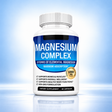
Alurevia Magnesium Complex uses eight named sources: glycinate, malate, citrate, taurate, oxide, carbonate, aspartate and orotate.
View Alurevia Magnesium Complex →
Frequently asked questions
How do I compare a supplement that lists elemental magnesium with one that lists the compound amount?
Convert both to elemental magnesium per day. Use the "Magnesium" line on the Supplement Facts panel where available, since it is already elemental. Otherwise multiply the compound weight by the form's elemental percentage, then by servings per day. Comparing cost per 100mg of elemental magnesium removes differences in bottle and serving size.
Is elemental magnesium a type of magnesium?
No. It describes the magnesium portion within a compound, rather than naming a separate compound.
Which form has the most elemental magnesium?
Magnesium oxide, at roughly 60% by weight, though it is also among the least well absorbed, so the highest percentage is not automatically the most useful.
Why do labels list compound weight at all?
Because that is what physically goes into the capsule. The Supplement Facts panel is where elemental magnesium is disclosed.
References
- National Institutes of Health, Office of Dietary Supplements. Magnesium: Fact Sheet for Health Professionals. ods.od.nih.gov
- Volpe SL. Magnesium. Advances in Nutrition. advances.nutrition.org
90-DAY SUPPLY · SUBSCRIBE & SAVE 10%
Make your 90-day routine automatic, and save.
One bottle contains 90 capsules at one capsule per day, so the subscription is designed around a full 90-day supply.
- $35.00 one-time purchase
- $31.50 every 3 months with Subscribe & Save
- Save $3.50 on every 90-day delivery
- Only 4 scheduled deliveries per year, not monthly
- No need to remember to reorder
- Pause, skip or cancel anytime
This article is general education about supplement labelling and is not medical advice. These statements have not been evaluated by the Food and Drug Administration. This product is not intended to diagnose, treat, cure, or prevent any disease. Follow product directions and speak with a healthcare professional for individual guidance.